1,5-Dibromopentane: Commentary on Industrial Relevance and Research Progress
Historical Development
Over the past century, chemists have relied on straightforward molecules like 1,5-dibromopentane to build more complex materials and develop inventive synthesis pathways. As organic chemistry advanced in the early twentieth century, halogenated alkanes drew attention for their reactivity and utility as building blocks. Laboratories and manufacturers noticed how molecules with bromine substituents on either end could anchor in synthetic processes that demanded predictable reactivity across a carbon chain. Over the decades, work in pharmaceuticals, polymers, and materials science turned to 1,5-dibromopentane as a core intermediate, especially when direct access to pentamethylene or similar backbones was crucial. The molecule’s track record highlights not only technical curiosity but the need for a straightforward approach to carbon chain extension and functional group installation—a requirement that hasn’t faded as industrial chemists chase better performance and sustainable manufacturing.
Product Overview
1,5-Dibromopentane offers a versatile two-bromine substitution pattern on a five-carbon chain, which gives it value for specialists and researchers alike. The substance generally appears as a clear, oily liquid, not far removed from its fellow alkyl bromides in appearance. As a difunctional alkylating agent, it easily slips into a toolbox for creating longer carbon chains and introducing various substituents through nucleophilic substitution. It’s not a showy chemical by itself, but people working with it know its value in facilitating organic transformations, supporting material modifications, and setting up more intricate couplings.
Physical & Chemical Properties
In my work, it’s always been clear that you can’t design a safe or effective process with 1,5-dibromopentane if you ignore its volatility and its weighty, slightly sweet odor. It boils at roughly 243°C and sits in a middle ground of density—heavier than water, lighter than most metallic bromides, clocking in around 1.56 g/cm3. Solubility tends to be low in water but strong in most common organic solvents. The chemical stability under cool, dry storage makes it practical, but the reactivity of bromine atoms on both ends means that extra caution is required to avoid unwanted side reactions. Ignoring run-of-the-mill reactivity or safety protocols, especially with alkylating agents like this, can spell trouble.
Technical Specifications & Labeling
Suppliers specify purity, moisture content, and color standards for 1,5-dibromopentane. Most laboratory-grade stocks list a purity of 98% or better, often with gas chromatography analysis backing up the figures. Typical containers include amber glass bottles or steel drums lined with chemical-resistant coatings. Labeling includes UN number 2680 for transport and hazard identification, a GHS corrosive symbol, and first aid summaries. In regions such as the EU or North America, suppliers attach strict documentation to shipments, allowing users to match every bottle to appropriate data on reactivity, disposal, exposure limits, and regulatory compliance.
Preparation Method
Commercially, bromination of 1,5-dihalopentanes or direct bromination of 1,5-pentanediol lays the groundwork for industrial-scale synthesis. I’ve seen small- and mid-scale labs use hydrobromic acid in the presence of dehydration agents to convert pentanediol, maximizing yield by closely watching reaction temperatures and adjusting bromine addition rates. Chasing higher selectivity and lower by-product formation, modern wisdom tends toward controlled temperature profiles and anti-bumping measures throughout the bromination. The drive for greener techniques, such as photochemical or phase-transfer catalysis, reflects the industry’s quest to reduce hazardous by-products and streamline purification.
Chemical Reactions & Modifications
Chemists often turn to 1,5-dibromopentane for nucleophilic substitution reactions. Attaching amines, thiols, or phenoxide ions to the ends turns it into a bridge for polymers or cyclic compounds. Its dibromo structure stands ready for alkali metal-induced couplings, enabling cyclization and ring formation. In the hands-on part of a lab, alkali reactions with 1,5-dibromopentane give way to tetrahydropyridine or azocine derivatives, supporting drug development and specialty materials research. The molecule adapts well to modification, often ending up as a linker in specialty polymers or contributing backbone flexibility to molecules used in biotech and electronics.
Synonyms & Product Names
Chemists recognize 1,5-dibromopentane by several names: pentamethylene dibromide, 1,5-pentanediyl dibromide, and sometimes just dibromopentamethylene. CAS number 111-24-0 appears on nearly every safety sheet or order form. Some suppliers use trade names or code numbers for large-scale shipments, but clear labeling always ensures buyers know what they’re getting. Alternatives like alpha,omega-dibromopentane appear in older literature and certain regulatory filings.
Safety & Operational Standards
Hands-on experience with 1,5-dibromopentane demands respect for its hazards. Contact can irritate the skin and mucous membranes, while inhalation of vapors poses risks to respiratory health. Facilities lay down rules for PPE: gloves resistant to halides, goggles, and exhaust ventilation in work areas. Storage stays in well-ventilated, cool, dry environments, away from heat sources or strong oxidizers. SDS documents detail accidental release measures and first aid steps, reinforcing a culture focused on practical safety rather than checklists. Emergency wash stations and containment kits play a key role in keeping incidents from escalating. For waste, regulations mandate collection of halogenated solvents as hazardous, avoiding environmental contamination at every step.
Application Area
Industry puts 1,5-dibromopentane to work as a cross-linker in polymer synthesis, as a precursor for pharmaceuticals, and as a backbone-building reagent for advanced cyclic structures. I’ve seen it bridge materials in specialty rubbers, create amine-functionalized intermediates for drug research, and play a quiet but critical role in the synthesis of complex molecules for biotech. Its ability to create five-carbon tethers with functionalized ends makes it a go-to for creating tailor-fit properties in resins and elastomers. For those designing new drugs or biodegradable polymers, this molecule often provides the flexible, reactive core that opens doors to new applications.
Research & Development
Research groups focus on smarter, safer synthetic routes to 1,5-dibromopentane, with a major push for green chemistry principles in recent years. I’ve watched teams switch from traditional bromination to catalytic, solvent-minimized pathways, trying to reduce waste and risk. Projects aiming to replace bromine altogether, or to recycle spent reagents after synthesis, suggest growing environmental responsibility. In the lab, the molecule often stands as a standard substrate for reaction optimization studies, letting chemists test catalysts or new reaction conditions on a reliable, well-understood backbone. Researchers test new applications—such as ionic liquid precursors, advanced surfactants, and even battery materials—hoping this “uncomplicated” molecule can answer newly complex questions.
Toxicity Research
Working with 1,5-dibromopentane, I’ve learned that its reputation for moderate toxicity must never be ignored. Animal studies show signs of central nervous system depression, as well as irritation and potential tissue damage on exposure. Chronic handling without protection brings risks of organ toxicity, particularly to the liver and kidneys. The bromine atoms intensify its alkylating ability, raising concerns about mutagenic potential and long-term effects. Regulatory agencies set occupational exposure limits and encourage regular health monitoring for at-risk workers. Ongoing research into metabolic breakdown products and bioaccumulation reflects a growing push for better medical understanding and safer handling.
Future Prospects
Looking forward, 1,5-dibromopentane will keep its place in the toolkit of builders of new molecules and materials. Industry will keep pressing for more efficient and sustainable synthesis, fueled by stricter environmental rules and market demands for greener products. As technology evolves, new catalysts, process automation, and real-time monitoring stand to make its production cleaner and less hazardous—potentially transforming this molecule’s image from industrial staple to model of safe, responsible chemical manufacturing. Scientists may find new ways to harness its reactivity for battery materials, high-strength polymers, or targeted drug delivery systems. As understanding grows, any move toward less toxic analogs and even bio-based alternatives will follow, yet the lessons learned from years of practical use—attention to safety, respect for reactivity, drive for efficiency—will shape every step ahead.
The Building Blocks in Organic Synthesis
Each time a new pharmaceutical, material, or specialty chemical shows up in the market, a flurry of molecules works behind the scenes. One that keeps chemists coming back is 1,5-dibromopentane. With two bromine atoms on either end of a five-carbon chain, it’s got a simplicity that turns out to be very handy. My first real brush with the substance came during an internship in a chemical synthesis lab—before that, it just occupied a line in my organic textbook. Soon I noticed that this molecule kept popping up as a problem-solver in everything from academic research to industrial applications.
Versatile Linker in Complex Molecule Design
Chemists often look for a way to piece together different fragments of a larger molecule. 1,5-Dibromopentane’s strong carbon-bromine bonds let it act almost like industrial double-sided tape. Drop it into the right reaction—say, an alkylation with a nucleophile—and you can link two separate groups straight down the chain. Drug development depends on these linkers. Say, you need to make a macrocycle or engineer a new catalyst system. This compound provides a solid backbone for joining things together.
Polymer Chemistry and Material Science
Polymers rarely start life as fancy household products. Manufacturers like to kick things off with a “monomer” and a “crosslinker.” These let them tailor strength, flexibility, and other properties for whatever the application demands. 1,5-Dibromopentane fills this crosslinker role well. Its two bromine atoms react with various monomers, making it possible to string molecules together in just the right arrangement. The chain length matters: five carbons hit a sweet spot between mobility and rigidity, which influences flexibility in polymers like specialty plastics and advanced coatings.
Specialty Chemicals: Fragrances and Flavors
Specialty chemical makers reach for building blocks like this to whip up a whole range of molecules—from solvents to fragrance and flavor ingredients. It’s not that this compound smells good on its own; it just helps lock together other groups, forming ring structures or linear intermediates. Synthetics like musk fragrances often get their start in chemistry labs with a simple dibromide like this. While ordinary consumers don’t read “1,5-dibromopentane” on labels, their everyday products can trace their ancestry back to it.
Laboratory Synthesis: An Educational Staple
If you’ve sat through advanced organic classes, there’s a good chance your hands have smelled faintly of bromine at some point. 1,5-Dibromopentane shows up in lab manuals as a safe, clear example of a dihalide. Its straightforward coupling reactions give students a hands-on lesson in nucleophilic substitution. Instructors appreciate its reliability and the fact that it lets students practice core skills before moving on to flashier, more sensitive reagents.
Looking Ahead: Sustainability and Safer Handling
Handling dibromides raises some flags, mostly because brominated compounds can carry health and environmental risks. Labs and factories work to keep exposures low; regulatory agencies like OSHA, REACH, and the EPA provide guidance on storage, transportation, and disposal. Lately, I’ve seen moves towards using more efficient reactions that create less waste or applying greener solvents. If the chemical industry keeps pressure on manufacturers to clean up syntheses and waste streams, the next generation will keep learning and innovating—without losing out on the benefits that straightforward molecules like 1,5-dibromopentane bring.
Understanding the Risks
1,5-Dibromopentane doesn’t show up in everyday life, but if you’ve spent time in a chemistry lab, you know its strong odor and reputation for hazards. It’s a colorless to pale yellow liquid that can quickly cause problems without proper care. This compound doesn’t need to touch your skin or get in your lungs for something to go wrong.
I’ve seen just how fast it can sting eyes or irritate skin even from a small splash. The vapor creeps into your nose and throat, making it tougher to breathe. Labs usually keep a close eye on who handles it and how they store it, and for good reason. Cases of chemical burns or respiratory symptoms after mishandling are not rare.
Personal Protective Equipment Isn’t Optional
The basics matter here. Splash-proof goggles stop liquid from sneaking in. Lab coats and gloves do more than keep uniforms clean. Nitrile or neoprene gloves cut down on the risk of skin absorption — latex doesn’t work as well with organobromines like this one. Remember, cotton or open footwear offers little protection if a bottle tips over. Closed-toe shoes make a real difference in an accident.
Ventilation Takes Top Priority
Too many people underestimate good airflow. Fume hoods give everyone a fighting chance if vapors escape. Don’t trust a regular bench for anything involving this chemical. I worked with a colleague years ago who tried to rush an experiment at her desk and ended up dizzy from fumes. Since then, I never skip the hood. Regular checks on hood function matter because a clogged filter or broken fan can be the difference between a safe shift and a medical emergency.
Storage and Spill Response
Storing 1,5-Dibromopentane in a flammable cabinet, away from strong oxidizers and acids, sets up a safer environment. Labeling everything with clear hazard warnings keeps confusion to a minimum. Even after careful use, spills happen. Granular absorbents (not sawdust) work best for cleaning. Never let anyone use bare hands; two pairs of gloves stand between you and a lasting burn. Disposal needs a chemical waste can, not the standard sink or trash bin.
Training Makes the Difference
Many accidents come from jumping into new procedures too soon. Refresher training every year reminds even the most experienced teams of the risks. I still remember my own mistakes as a student. The only thing that stopped permanent injury was an instructor’s quick thinking and a working eyewash station. Everyone should know the location of emergency showers, eyewash stations, and exits by heart.
Building a Safety Culture
Open communication about close calls and near-misses helps others learn before injury happens. Encouraging questions and sharing checklists prevent arrogance from taking root. In my labs, we kept “safety debriefs” after major projects and always found ways to tighten our systems. Investing in safety gear and proper storage pays off far more than any cleanup or medical bill.
1,5-Dibromopentane reminds us that chemicals don’t forgive shortcuts. With the right equipment, habits, and attitude, the risks stay manageable and everyone goes home healthy.
Chemical Formula and Structure
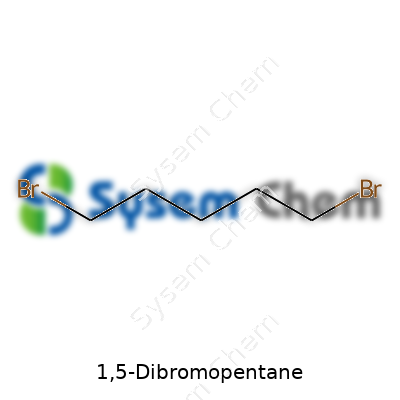
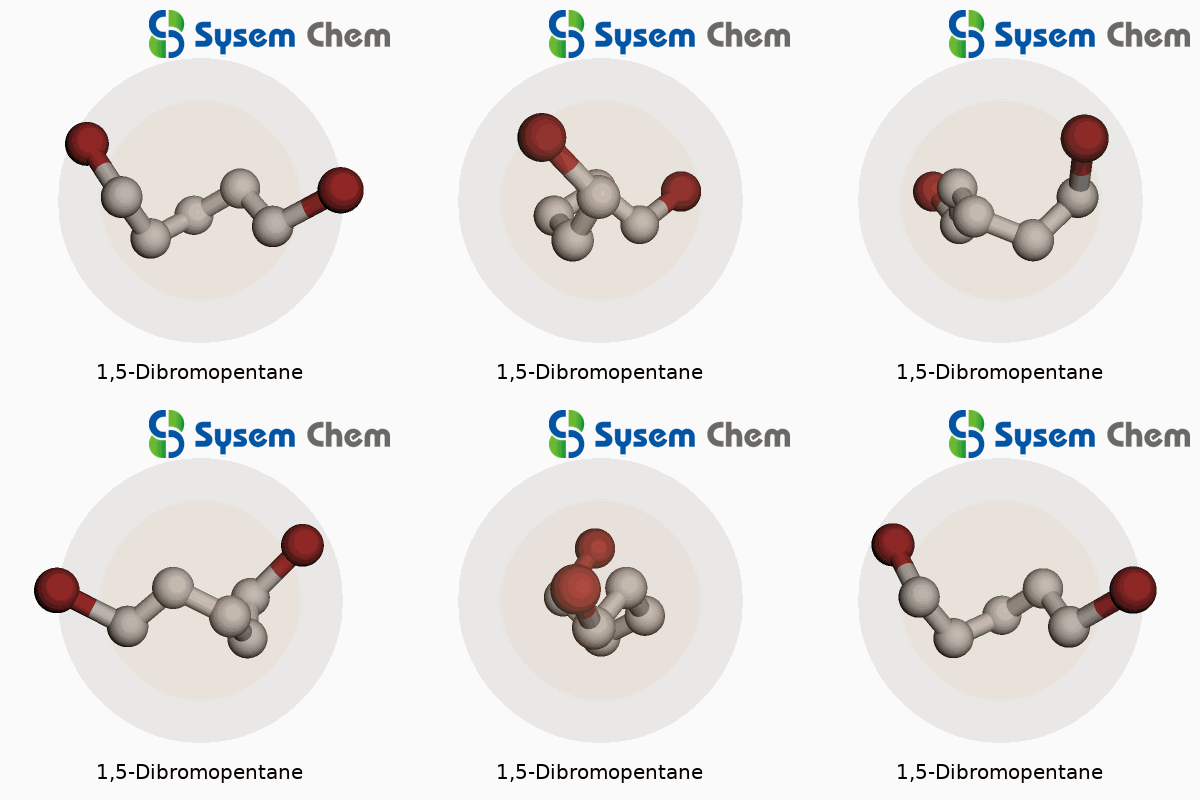
1,5-Dibromopentane comes with a straightforward formula: C5H10Br2. Its skeleton tells a clear story—five carbons in a row, each holding onto their hydrogens, but both ends are capped by bromine atoms. The structure looks like Br–CH2–CH2–CH2–CH2–CH2–Br, forming an unbranched chain. Both bromines attach to the first and fifth carbons, which shapes the identity of this compound and dictates its reactivity.
Practical Relevance in Synthesis
Working in a chemistry lab, you often see 1,5-dibromopentane show up on shelves where functional group transformations matter. Two bromines mean two reactive spots, which opens the door for making rings, chains, and connections across molecules. In the real world, this reagent plays a part in building blocks for drugs, polymers, and specialty chemicals, not just as an academic curiosity. Creating cyclic compounds with five atoms in the ring—like pyrrolidines and piperidines—becomes a whole lot easier when both ends of a molecule sport good leaving groups like bromine.
It also teaches beginners something fundamental about organic chemistry: increase the distance between reactive sites and you're not just doubling your chances for chemical change, you’re opening up the possibility of more controlled synthesis. It's this distance between the bromines that turns “just another alkyl halide” into a scaffold for more complex chemistry.
Risks and Handling
Brominated compounds carry baggage. Personal experience in the lab tells you that many bromine reagents bring some risk, from breathing issues to skin reactions. 1,5-Dibromopentane isn’t the most volatile, but splashes or careless handling let bromine atoms do work you weren’t planning. Careful weighing, gloves, and good ventilation pull their weight every time this bottle comes out. Handling it with respect and well-ventilated space keeps accidents off the report log and skin irritation out of sight.
Use in Industry and Research
You spot 1,5-dibromopentane most often in organic synthesis. It acts as a linker, tying two reactive partners together across a five-carbon bridge. Polymer chemists put this reagent into cross-linking reactions, often designing polymers with predictable, repeatable features. Medicinal chemists count on these dibromoalkanes to help build molecular frameworks that will one day turn into drug prototypes. In materials science, 1,5-dibromopentane offers a practical starting point for tailored nanostructures. Its repeatable structure makes it a tool rather than a goal, like a wrench in a mechanic's kit.
Sustainability and Safer Alternatives
Not every process needs a brominated chain, especially given the steady push toward greener chemistry. Regulatory bodies have started questioning the use of halogenated solvents and reagents, especially when safer or more biodegradable options exist. Chemists have cut down on excess and waste, using catalytic or alternative strategies where possible. Sometimes switching to less persistent halogens or redesigning the synthetic path can help. In my own projects, I’ve seen teams shift to more selective catalysts or swap in milder reagents, reducing both toxicity and costs. This kind of rethink reflects a broader move across the field: keeping reactivity high without ignoring the bigger picture.
Knowing What’s in the Drum
1,5-Dibromopentane belongs in the same family as other alkyl halides—a group I’ve seen handled often in academic labs and in industry settings. This liquid carries both fire risk and health hazards. Leave a cap loose and the fumes start drifting. Any seasoned lab worker can recall a story about a bottle that got ignored in a corner, discovered only when the faint, biting smell began to crawl through the air. One time in graduate school, a poorly sealed chemical started to eat the label right off its own bottle. Those details stick for a reason: they serve as hard reminders to treat every material on the shelf with respect, especially those that can cause skin burns, lung irritation, or worse.
Location Always Matters
Shoving a bottle wherever there’s space isn’t just lazy, it’s flirting with disaster. 1,5-Dibromopentane stays stable enough under common conditions, but mix it with open flames, heat, or powerful oxidizers and things can go wrong quickly. Out in the field, chemical storage mistakes look like swollen containers, yellowed liquids, or rusted caps—most often caused by heat and sunlight. Once, a delivery arrived and the shipping box sat outside too long in the sun; inside, the bottles almost felt hot to the touch.
A cool, dry storage cabinet with solid ventilation saves more than just paperwork headaches. Concrete floors and steel cabinets resist spills and fire. Store away from acids and oxidizers, never stacked beside old paint cans or cleaning supplies. Firefighters who visit labs for inspecting always check for flammable cabinet markings and chemical logs, since clean storage slows down disasters and helps them do their job quickly.
Don’t Skimp on PPE
Every time a new tech joins the team, the safety talk gets real: gloves, goggles, and long sleeves. My first week working with alkyl halides, a careless splash forced an emergency room visit for a colleague. No one goes near 1,5-Dibromopentane without personal protective gear—skin burns heal, but some exposures leave lasting damage. Companies that train on real cases see fewer injuries, and the message sticks better than any slide show.
Record-Keeping Prevents Regret
Misplaced chemicals cause confusion during audits and emergencies. Maintaining a logbook, updating the shelf each time a bottle moves, and clear labeling all reduce mistakes. I’ve seen labs lose grant funding from regulatory fines, just because a chemical like 1,5-Dibromopentane got left off the inventory or showed up in the wrong cabinet. Label everything with dates and hazard warnings, double check every bottle before putting it away, and you avoid costly surprises.
The Bigger Picture—People, Not Just Regulations
Handling toxic or flammable liquids builds a culture as much as it follows rules. Watching an experienced chemist handle storage isn’t about paranoia but care—for themselves, for everyone else in the building, and for the environment. Store hazardous materials right, and you protect the health of the community as well as precious research. Taking shortcuts may save a few minutes, but careful storage saves lives and reputations.
Looking Forward: Better Solutions
Modern storage cabinets now come with spill trays, self-closing doors, and built-in exhaust ports. Investing in proper equipment, clear training, and mutual accountability creates safe workplaces with fewer accidents. Researchers and plant workers all have a hand in keeping 1,5-Dibromopentane—and every chemical—stored away from trouble.
Where Science Meets Practice: Peering into 1,5-Dibromopentane
Stop for a second and imagine a clear, slightly oily liquid sitting quietly in a lab flask. That’s 1,5-Dibromopentane, a dibromoalkane that tends to slip under the radar unless you spend time around synthesis benches or in an organic chemistry class. With a formula of C5H10Br2, this compound stands out for more than just its bromine atoms. The chain structure — five carbon atoms with a bromine stuck to each end — offers some unusual behavior worth talking about.
Physical Traits: More Than Meets the Eye
1,5-Dibromopentane doesn’t flash or fizz. It shows up as a colorless to pale yellow liquid. On the scales, its density clocks in around 1.57 grams per cubic centimeter, heavier than water. Its boiling point—set around 242°C—shows it won’t disappear into vapor easily. In the fridge, its freezing point lands near -19°C. This stays liquid in many common conditions, so handling isn’t too tricky if you keep spills at bay.
If you try mixing it with water, you’re out of luck. It doesn't want to dissolve. Add it to organic solvents like ether or chloroform, and you’ll see the opposite. This non-polar nature means storage requires some basic sense: keep it in a tightly closed container, away from anything that reacts badly with halogens.
Chemical Properties: Why It Matters to Chemists
It’s not just about a couple of bromines on a chain. Those bromine atoms load the molecule up with polar bonds, making the carbon-bromine ends pretty reactive. Chemists often use it as a building block, linking molecules by replacing those bromines in nucleophilic substitution reactions.
That characteristic makes it valuable in making cyclic compounds, especially piperidines and pyrrolidines. You find these targets scattered across pharmaceuticals and specialty polymers. If you work with Grignard reagents or metal-halide reactions, 1,5-Dibromopentane serves as a useful intermediate, letting you connect or modify molecular chains without jumping through hoops.
Handling, Health, and Practical Considerations
Let’s be honest, 1,5-Dibromopentane isn’t something you want to splash around. It gives off a sharp, sometimes irritating odor and can bother skin, eyes, or lungs on contact. You should always keep gloves and goggles handy, and never forget the fume hood. Studies flag many brominated organics as persistent in the environment, so disposal needs thoughtfulness: proper waste collection and incineration, never a rinse down the drain.
In my own research experiences, things got messy if even a small leak happened. The material lingers on benches, so cleaning becomes a full job. A small spill leads to a strong, persistent scent that sticks around for days—a signal to take safety seriously.
Looking Ahead: Safer Chemistry and Better Practices
Chemical supply keeps evolving. Companies now track every step from production to waste, matching tighter rules. Some labs seek out alternatives to dibromoalkanes, aiming to cut risks to health and the environment. Switching to less hazardous halides remains a challenge for chemists who need that unique five-carbon backbone. So, the push continues for new green chemistry solutions—methods that keep the benefits without piling on new risks.
1,5-Dibromopentane won’t show up in the headlines. Still, it’s part of a much bigger puzzle: understanding what’s in our bottles, how we use it, and what footprint it leaves behind. That’s a lesson every researcher picks up, one flask at a time.