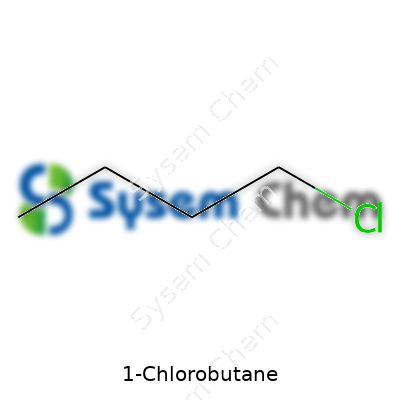
1-Chlorobutane: A Closer Look at a Common Alkyl Halide
Historical Development
Back in the days before synthetic chemistry became huge, chemists learned to turn alcohols into other useful molecules by swapping out the hydroxyl group. Near the end of the 19th century, they realized butyl alcohol could transform into something completely different after reaction with hydrochloric acid. This breakthrough introduced the world to 1-chlorobutane. As research pushed forward, chemists saw how this simple process paved the way for larger developments in alkyl halide synthesis. Years ago, older textbooks listed chlorinated organics for their roles in building blocks or reagents, and 1-chlorobutane appeared again and again because it let researchers walk their way along the chain of carbon atoms, building ever more complex molecules from humble beginnings. Over time, demand for synthetic pathways increased in rubber, pharmaceuticals, and solvents, with 1-chlorobutane remaining a dependable stepping stone through every shift in industry.
Product Overview
1-Chlorobutane stands as a clear, colorless liquid. Chemists see it as an effective alkylating agent, thanks to the arrangement of its atoms – four carbons in a row, chlorine sticking off the end. It doesn’t owe its importance to complexity, but to the way it bridges the gap between basic hydrocarbon chemistry and the tailored needs of modern application areas like pharmaceuticals, specialty solvents, and agrochemicals. Industrial-scale companies often rely on its reactivity, treating it as a blank slate for new compounds, feeding downstream production lines that crave such starting materials. Niche labs still keep it around for organic synthesis teaching and small-batch sample preparation, making sure each step builds off the same trusted chemistry.
Physical & Chemical Properties
This molecule features a boiling point near 78°C and a melting point hovering well below freezing. Volatile, with a sharp odor, users notice its similarity to other light chlorinated alkanes. It doesn’t mix well with water but dissolves in common organic solvents like ether or acetone. From direct work in the lab, a bottle left open for a few minutes can fill the room with fumes, warning of its ability to evaporate quickly. Chemically, it possesses the kind of reactivity that makes it popular – that terminal chlorine atom is eager to be swapped out by a range of nucleophiles, allowing 1-chlorobutane to serve as a backbone for producing amines, ethers, and more.
Technical Specifications & Labeling
Any reputable chemical distributor provides 1-chlorobutane with a purity above 99%. On the label, you’ll find its CAS Number: 109-69-3, the clear chemical structure or formula C4H9Cl, and hazard indicators for flammability and toxicity. Handling instructions never seem excessive after reading about personal exposure effects, and material safety data sheets (MSDS) drive home the need for gloves, good ventilation, and goggles. Trace impurities like 2-chlorobutane, residual butanol, or acid residues must stay minimal, since they interfere with the most sensitive synthetic reactions or downstream uses.
Preparation Method
Labs make 1-chlorobutane by treating n-butanol with hydrochloric acid. This classic nucleophilic substitution sweeps off the hydroxyl group and lets a chloride ion move in. Some commercial routes stream butanol and gaseous HCl through continuous reactors at controlled temperatures, separating the denser chlorobutane out later. Alternatively, older prep relied on phosphorus trichloride with butanol, yielding the product and leaving behind messy phosphorus acids for disposal. These days, companies seek routes that cut down on toxic byproducts for safety and waste management reasons, keeping both workers and the environment in better shape.
Chemical Reactions & Modifications
Out in the wild world of organic synthesis, 1-chlorobutane offers everything a researcher could want from a simple reactive molecule. Nucleophilic substitution stands as the main act – reacting with sodium cyanide creates pentanenitrile, swapping chlorine with sodium ethoxide lets you step forward to butyl ethyl ether, and so on. Nearly every textbook problem about SN2 reactions includes this compound because its unbranched chain allows direct attack with few complications. Alkyl lithium and Grignard reagents pop up too, letting you use 1-chlorobutane as a base for carbon-carbon bond formation in synthetic planning. For those who push molecules further, elimination reactions convert it into 1-butene, shifting focus from halides to alkenes and broadening the toolbox of downstream chemistry.
Synonyms & Product Names
Beyond 1-chlorobutane, users refer to this molecule as n-butyl chloride, butyl chloride, or simply 1-chlorobutane in catalogues. International markets sometimes label it as chlorure de butyle-1 or cloruro de butilo, but each time, the core structure holds steady. In lab discussions, “n-butyl chloride” flows off the tongue since it separates this molecule from its isomer, 2-chlorobutane, which reacts differently due to its secondary structure. Keeping track of synonyms matters when ordering or cross-referencing older research reports, making accuracy more than just a paperwork task.
Safety & Operational Standards
Experts in occupational health know volatile chlorinated organics require respect. 1-Chlorobutane acts as both a skin and respiratory irritant, so working with it always means donning gloves and eye protection. Spills and leaks stand out immediately due to that penetrating odor and the speed it vanishes into the air. Labs must run under fume hoods to avoid chronic exposure, and any large-scale handling comes with strict requirements for fire protection due to its low flash point. Chemical companies lay out explicit storage rules: separate from oxidizers, out of direct sunlight, away from ignition sources, and tightly sealed. Training workers on emergency measures remains a top priority alongside technical guides.
Application Area
The reach of 1-chlorobutane spreads wider than its simple structure lets on. In agrochemical synthesis, it provides the backbone for herbicides and certain pesticides. Pharmaceutical labs wheel out the reagent cart for 1-chlorobutane whenever they need to tack a butyl group onto a drug molecule, fine-tuning biological properties or absorption rates. Companies use it as a solvent in extraction processes, and in some rubber manufacturing, it adjusts polymer properties by modifying side-chains or acting as a chain transfer agent. For specialty chemical production – surfactants, flavoring additives, even dyes – it steps forward with reliable reactivity and compatibility. Small-scale specialty reactions sometimes show off its strengths for academic training, especially in teaching labs introducing reaction mechanisms.
Research & Development
Research into 1-chlorobutane keeps stretching forward as chemists seek greener synthesis methods and safer reaction conditions. Replacing old, hazardous reagents like phosphorus trichloride with more benign chlorination agents helps to limit toxic waste. New catalytic systems cut down on energy requirements, responding to economic and environmental pressures. Universities put the molecule to work in studies of reaction kinetics, solvent effects, and stereochemical outcomes, making it a mainstay of organic laboratory courses and educational research. Innovative synthetic projects look to 1-chlorobutane for building custom surfactants, biodegradable materials, and intermediates for personalized medicine. As analytical technology sharpens, precise monitoring of trace residues in finished products adds another layer of scrutiny and improvement, creating benchmarks for quality and safety.
Toxicity Research
Concerns about toxicity shape policies in chemical manufacturing. Inhaling 1-chlorobutane vapors leads to symptoms like dizziness, headaches, or drowsiness. Chronic exposure creates longer-term issues: liver and kidney stress in animal studies, and potential nervous system effects if workplace air isn’t managed well. Skin or eye contact irritates fast and sharply, with dermatitis or chemical burns possible after spills or accidental splashes. Researchers have chased down the metabolic fate of this alkyl chloride, noting how it tends to create reactive intermediates in the body, which can inflict cellular damage with repeated doses. Regulatory agencies track these findings closely, setting exposure limits and labeling rules to keep occupational health front-and-center. Better ventilation standards, detection technologies, and more precise risk assessments come from this stream of research.
Future Prospects
Looking ahead, 1-chlorobutane occupies a steady, if quiet, place in chemical synthesis and industrial scale-up. Companies lean toward safer, cleaner processes, investing in closed-loop systems and automation to limit both exposure and waste. The quest for renewable sources influences how base materials like butanol, once fossil-derived, now gain attention from bio-based feedstocks. Synthetic routes are evolving, designed to slash environmental footprints while keeping product yield high. Regulatory pressure in Europe, North America, and Asia continues to drive these trends. For research labs, future questions focus on new reaction applications and improved analytical tools for trace analysis. Cross-sector collaboration with environmental scientists, healthcare professionals, and industrial engineers promises to lift safety and sustainability standards.
Unseen but Essential in Industry
Walk into a chemistry lab, and 1-chlorobutane sits tucked away among more glamorous chemicals. This clear, colorless liquid runs through the veins of many industrial processes. In many ways, it behaves like a tough workhorse, often overlooked but always reliable. I’ve come across it in industrial settings plenty of times, especially in places focused on chemical production. Its value isn’t about being rare—it comes from its ability to act as a building block.
Key Role in Chemical Synthesis
One of the main reasons manufacturers reach for 1-chlorobutane is its use as an alkylating agent. It’s a solid starting material for building other chemicals. Companies working on pharmaceuticals depend on 1-chlorobutane to kick off reactions leading to drugs that treat real health problems. As an example, it helps form butyl derivatives—compounds that end up in medicine, fragrances, and flavors.
Making solvents is another big application. Factories take 1-chlorobutane and modify its structure to create new compounds that dissolve tough substances. These specialty solvents go into coatings and inks, helping products dry faster or last longer under hard use.
Fuel Additives and Rubber Manufacturing
Fuel companies blend additives from byproducts of 1-chlorobutane. These additives help gasoline burn cleaner or boost its octane. That seems small, but every cleaner burn means less pollution. While most drivers don’t think about the chemistry in their tank, I’ve seen how critical it is in regions pushing for lower emissions.
Rubber makers use 1-chlorobutane as a chain transfer agent. The science might sound technical, but it’s really about controlling the texture and durability of rubber. Car tires, shoe soles, even elastic bands—these everyday products rely on the careful chemistry involving 1-chlorobutane to get the right stretch and bounce.
Health and Safety: Risks and Approaches
Alongside its utility, 1-chlorobutane brings health concerns. Workers exposed to high concentrations risk irritation of their eyes, skin, and lungs. Studies have shown that in unventilated spaces, vapors can collect and cause headaches or worse. Regular training and improved workspaces cut back on accidents, but small manufacturers sometimes cut corners. Over the years, I’ve seen stricter guidelines from environmental agencies making a difference, yet there’s still room for improvement in how facilities monitor and handle chlorinated chemicals.
Toward Safer and Greener Alternatives
Green chemistry trends invite the industry to consider alternatives. Some researchers look for less volatile reagents that deliver the same results with fewer risks. Switching to closed systems, where human contact is limited, already protects many workers. Tracking exposures and sharing data across companies help spot trouble before it grows.
The backbone of much chemical progress, 1-chlorobutane rarely lands in headlines, but scratch beneath the surface of countless products—medicines, fuels, synthetics—and you’ll find its signature. Its safe and sustainable use reminds everyone in the field to balance utility and responsibility, because no matter the industry, cutting corners is never worth the risk.
Getting Down to the Facts
Everyone who’s spent some time in a chemistry lab recognizes 1-chlorobutane. This is an organic compound with the formula C4H9Cl. Four carbon atoms, nine hydrogen atoms, and one chlorine atom come together to make up this relatively simple molecule. These details aren’t just for textbooks. I remember the first time I held a bottle labeled “1-chlorobutane”—the sharp, solvent-like odor makes it memorable, the clear structure even more so.
Why Knowing the Chemical Formula Matters
Some folks might look at this formula and think it’s just another line on a label. My experience tells a different story. The formula isn’t just academic—it's the jumping-off point for deciding how the chemical gets used, what safety gear comes out, and how it interacts with everything from glassware to skin.
Colleges store 1-chlorobutane for teaching organic chemistry, particularly for substitution and elimination reactions. Industries rely on it to make other chemicals and as a solvent. The simplicity of the formula helps professionals predict behavior. That lone chlorine atom, for instance, loves to switch places in reactions, removing guesswork during synthesis. Knowing it’s a four-carbon chain with a terminal chlorine keeps things straightforward, cutting down on mistakes.
Handling and Health: Not Just Numbers
I once watched a classmate rush through a reaction involving 1-chlorobutane. Gloves went ignored, and next thing, the headache set in—vapors from even short exposure cause problems. Understanding that formula goes beyond balancing equations. C4H9Cl isn’t water or table salt. Chlorinated compounds like this one often require good ventilation and skin protection.
Mistakes stack up when people don’t recognize the specifics that come from the formula. That extra hydrogen compared to 1-chloropropane or the difference between straight and branched chains—they all change reactivity and toxicity. Looking up the formula before a practical session or an industrial order cuts down on the sort of slip-ups that send people to the safety shower or, worse, the hospital.
Environmental Responsibility Starts Small
The formula C4H9Cl doesn’t stop at health in the lab. There’s a larger duty to think about what happens after disposal. Chlorinated compounds like this one can linger in water or soil, sometimes causing trouble for wildlife. Having worked with waste disposal teams, I’ve learned the importance of identifying chemicals by structure. Even small amounts that go down the wrong drain add up over time.
There’s a clear path forward: proper storage, labeling, and waste collection. Many labs now keep up-to-date reference sheets, making the chemical make-up and hazards obvious at a glance. Modern policies push everyone in the direction of small waste streams and big accountability. It’s not always glamorous, but it keeps the lessons of that formula embedded in daily work.
Building Chemical Confidence
C4H9Cl isn’t just trivia for chemists. It’s a practical tool, a warning on a label, and a lesson in responsibility. Whether in the classroom or the industry, recognizing the meaning behind these symbols shapes not only the chemistry at hand but also the culture around it. For those new to the trade, keeping the formula in mind leads to accuracy, safety, and better habits. For those with more years under their belt, it reinforces reasons for the routines and reminders we pass on to anyone just picking up a bottle for the first time.
Real Dangers, Everyday Uses
Many people have never heard of 1-chlorobutane unless they work in a lab or an industry that uses chemicals. It’s a clear, colorless liquid and smells like ether, so it doesn’t jump out as something dangerous at first glance. Used as a solvent and sometimes as an intermediate when making pharmaceuticals or other chemicals, it pops up in places you might not expect. But what does that mean for our health or the environment?
Direct Contact: Not a Joke
I remember my first college organics lab—nobody liked handling chlorinated solvents without gloves. 1-chlorobutane can irritate skin and eyes pretty fast, leaving behind redness and discomfort. It absorbs through skin in large enough amounts to make a difference. Accidental splashes can send anyone to the eyewash station or have them running cold water over their hands. The worst cases can even lead to burns.
Breathing It In
The bigger risk comes from inhaling its vapors. Breathing in 1-chlorobutane can leave someone dizzy, nauseous, or with a headache. The central nervous system takes a hit, and at higher exposures, breathing problems or unconsciousness kick in. I know a few folks who’ve gotten careless in poorly ventilated spaces—waking up on the floor is a lesson no one wants twice.
Long-Term Health Effects
Most folks get nervous about cancer risks with chlorinated compounds. There isn’t enough long-term data on 1-chlorobutane to prove it causes cancer or reproductive harm, but that doesn't mean it’s risk-free. The U.S. EPA and OSHA don’t classify it as a likely carcinogen, but animal studies suggest chronic exposure could be worse than we know. In my experience, people don’t always see danger if a chemical isn’t famous for being toxic. That can have real consequences.
Environmental Concerns
Spills matter, especially near water. If 1-chlorobutane gets loose in the environment, fish and small aquatic life suffer most. The stuff floats on water and breaks down slowly, so it sticks around where it doesn’t belong. I once volunteered during a chemical spill cleanup near a small stream; watching dead fish wash up felt like a gut punch. It highlighted how even routine industry chemicals change the local ecosystem if handled carelessly.
Handling and Solutions
Personal safety starts with basics: gloves, goggles, and solid ventilation. Companies that store or use large amounts must take secondary containment seriously. Emergency procedures can’t just live on paper—regular drills make all the difference when something goes sideways. Investing in less hazardous solvents where possible pays off, not only for worker health but for environmental protection. Substitution works, but transparency about what gets replaced should be part of the conversation; we don’t want one hazard swapped for a new mystery.
Making Smarter Choices
Folks in schools and research labs often use 1-chlorobutane because it’s cheap and reliable for certain reactions. Understanding the risks upfront leads to better decisions down the line. Labels need to stay clear and up-to-date. Simple things, like storing it away from heat and out of sunlight, go a long way. Letting people know what symptoms look like and how to respond saves stress later.
1-chlorobutane has a place in science and industry, but the risks aren’t something to shrug off. Careful handling, honest reporting, and safer alternatives where reasonable make a real impact. The goal isn’t to create panic—it’s to make sure everyone knows what’s in the bottle and what it can really do.Keeping People Safe Around 1-Chlorobutane
Walk into any working lab or industrial setting, and you may spot containers labeled 1-chlorobutane stacked on shelves. This chemical serves a purpose in many manufacturing lines and research jobs, but nobody should get too comfortable with it. I once visited a facility where folks thought wearing gloves was good enough. One careless move, a slight spill, and the room filled with that sharp, ether-like smell. The person exposed to the vapor got a pounding headache and red, irritated skin. Treating these symptoms as harmless ignores the real risk.
Exposure to 1-chlorobutane goes beyond discomfort. Inhaling its fumes or letting it soak into skin can harm your health in subtle ways—dizziness, drowsiness, and even harm to the liver after repeated contact. Data from hazardous materials safety sheets confirm its flammability and toxic effects. Standing near an open container becomes a lot less trivial when you remember that it only takes a single spark to set off a fire.
Storing 1-Chlorobutane With Care
Routine sometimes breeds shortcuts, so people stack drums of chemicals without much thought. For 1-chlorobutane, smart storage means keeping containers in cool, well-ventilated spaces clear of sunlight, heaters, and flames. Back in my chemistry days, the bins marked ‘flammable liquids’ always sat away from break rooms or busy hallways, and for good reason. Vapors can hang in the air and wander; if they reach a hot motor or fuse, the outcome gets ugly.
It makes sense to only break open what you need for the job. Caps must be screwed on tightly after pouring. Labels should always be visible, with no faded ink. I’ve seen coworkers reach for the right-shaped container, uncertain what sat inside, and decide to “take a chance.” That’s how mistakes happen—make sure you can see exactly what’s being handled. Always choose glass or HDPE containers certified for corrosive chemicals, since 1-chlorobutane can chew through cheaper plastics over time.
Reducing Risks in Daily Use
Standard PPE like goggles, thick nitrile gloves, and long-sleeved lab coats offers a basic shield. Breathing masks or fume hoods keep vapors from crowding the workspace. Regular air monitoring lessens the danger, especially after an accidental splash or spill. If you detect a leak, clear the area and bring out proper absorbents—never let someone try mopping this up with a bare rag. Emergency showers and eyewash stations should work and stay unblocked; time wasted looking for one can turn minor exposure into a medical situation.
In my experience, quick training drills help keep routines fresh. Practicing spill cleanup or evacuation for a few minutes each month pays dividends if something ever goes sideways. Documentation beats guessing, so record quantities stored, note any near-misses, track expiration dates, and rotate stock accordingly.
Staying Mindful Prevents Accidents
For all the laboratory upgrades, nothing beats common sense and a touch of caution. Most accidents I’ve witnessed started with someone thinking, “It won’t happen to me.” Respect for a chemical like 1-chlorobutane means doubling down on safety habits: store away from heat, stay alert to vapors, label clearly, and keep gear ready. Every step, from storage to cleanup, multiplies the odds that everyone goes home healthy—and that’s why every detail matters.
Getting to Know 1-Chlorobutane
1-Chlorobutane holds a simple enough structure: a four-carbon chain with a chlorine atom wrapping up one end. It shows up as a clear, colorless liquid that carries a sharp and sometimes fruity scent. The formula looks like C4H9Cl, and this small tweak from butane—swapping one hydrogen for a chlorine—brings out a set of chemical tricks not found in the original molecule. I remember the first time a spilled beaker left that telling odor around the lab, lingering even after plenty of air had passed through open windows. This sharpness, both chemical and sensory, sticks in your mind.
Physical Properties Matter in the Real World
Temperature shapes how 1-chlorobutane acts. It boils at about 78 °C, slipping past water and beating out its close cousin butane by quite a margin. That means on a hot day, it can head for the air in an open container. The liquid itself sinks just a little on water, with a density hovering around 0.89 g/cm³. This tells you it will float, but only just. It slips through oil without much fuss and doesn’t dissolve in water. That poor solubility—at around 0.09 g/l—means spills travel quickly on a stream’s surface, carrying both hazards and that unmistakable chemical whiff.
The flash point speaks volumes to anyone working with flammables; 1-chlorobutane lights up at about 7 °C. One spark in a chilly lab can do real damage. Gloves and fume hoods aren’t just suggestions—they’re the bare minimum. Though the liquid doesn’t look threatening, a tiny flame can turn it to vapor in a blink.
Playing With Chemistry: Reactivity and Uses
Swap in a single chlorine, and butane gets a whole new side. This little tweak creates what folks in the lab call a “good leaving group.” The chlorine at the end gets nudged out in many reactions. A nucleophile—a chemistry regular—walks right up and bumps the chlorine out, creating all kinds of products. It’s a textbook case of an SN2 reaction, with one atom pushing out another in one smooth move. That makes 1-chlorobutane popular for making bigger molecules, from perfumes to lab intermediates.
1-Chlorobutane isn’t in most household cabinets, but industries lean on it. It helps build dyes, pharmaceuticals, and pesticides. Over the years, green chemistry folks have pointed out the problem: spills and leaks pose risks. Chlorine-containing compounds can stick around in the environment and break down slowly, if at all. This brings headaches for water testing and waste treatment. My own time spent on hazmat drills taught me chlorine organics like this aren’t easy to scrub out of soils or streams once they’ve spread. Proper storage—like sealed, well-ventilated spaces—keeps risks down.
Pushing for Safer Chemistry
Safe handling stands out as the best solution. Wear goggles and nitrile gloves; use a ventilated hood, and keep fire far away. Even more, researchers keep looking for replacements with fewer environmental hang-ups. Chlorinated solvents pop up everywhere in industry, but safer alternatives make real dents in pollution. Teaching students to respect, not fear, chemicals like 1-chlorobutane feels like the first step—knowing both what’s dangerous and what can be used to build something new.
At the end of the day, for everyone from high school students to seasoned chemists, understanding the quirks of 1-chlorobutane provides a chance to learn from each spill, each reaction, each day in the lab. These lessons, messy as they sometimes get, shape safer and smarter chemical work for everyone.